Rare Disease Discovery
We help families stuck in a diagnostic limbo find answers!
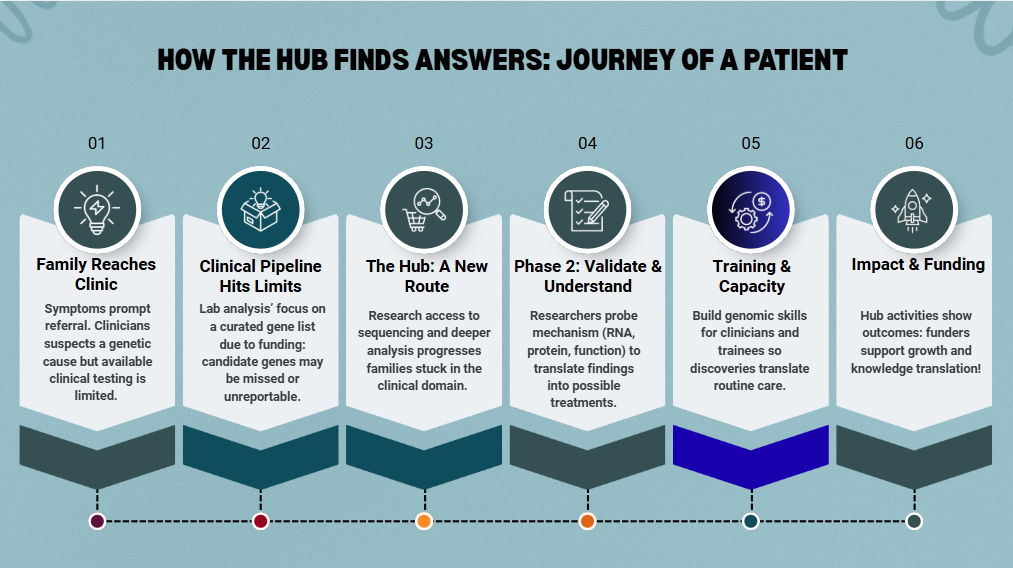
Many children carry genetic changes that standard clinical tests can’t fully explain. At the Rare Disease Discovery Hub we go further: we re-analyze clinical data, use advanced sequencing (including long-read and RNA testing), and run lab experiments to figure out whether a DNA change actually causes disease. We bring together clinicians, geneticists, lab scientists and genetic counsellors to build a step-by-step plan tailored to each child: including testing parents and siblings to see whether a variant was inherited or appeared new.
What we do for families:
- Re-review clinical genetic tests and perform deeper sequencing when needed.
- Use segregation testing (blood or saliva from relatives) to check whether a variant tracks with illness or is found in healthy family members.
- Run laboratory functional studies (cell models, protein assays, RNA/splicing tests) to understand how a variant affects biology.
- Provide clear counselling: we explain what tests can and can’t tell you, and we avoid creating false hope.
Why it matters?
A confirmed diagnosis can end years of uncertainty, inform medical care, and guide family planning. Even when a definitive answer isn’t found right away, our team’s investigations build the knowledge that helps future families. The Hub’s work is collaborative, patient-facing, and grounded in realistic, careful science.
Precision Health
Turning discoveries into fairer, faster, and more personal care!
Precision Health is how we move from discovery to real clinic impact. While the Hub focuses on genetics, the Precision Health Initiative (PHI) expands the toolbox by adding cell models, protein and metabolite testing, and other methods to translate lab findings into practical care. PHI trains clinicians and researchers, builds technical capacity on campus, and helps convert experimental tests into options that can be used safely in routine care.
What PHI enables:
- Faster translation of new tests (for example, RNA and long-read sequencing) into clinical pathways.
- Development of patient-derived cell models and isogenic stem-cell lines to test whether a variant causes disease and whether a therapy might help (without exposing a child to experimental treatment).
- Training and knowledge translation so clinicians can interpret complex genomic results and discuss realistic options with families.
Our approach and ethics:
We choose tests carefully and report results responsibly aiming to expand what’s possible while being transparent about limits. PHI is about building a toolbox that researchers, clinicians, and families can rely on to make better, personalized decisions.
CHILD Study & Microbiome Research
Following children from pregnancy onward to understand how early life shapes respiratory and immune health!
The CHILD Study is a long-term birth cohort that tracks children from pregnancy through childhood to map how early exposures, including the community of microbes that live in and on us, influence the development of asthma, allergies, and immune health. By combining clinical data with microbiome sequencing and social/environmental information, we can identify patterns that predict who will develop respiratory problems and why.
Why the microbiome matters?
- Changes in early microbiome composition (for example after C-section or antibiotic use) are linked to higher risk of asthma and allergy. The CHILD Study aims to pinpoint these links so we can design practical prevention strategies.
How the research helps real people:
- Findings have guided public health thinking and informed policies that reduce childhood respiratory disease risk.
- The study follows thousands of families across Canada, and continues to publish results that shape clinical care and prevention.